

The Energy Behind A Transformative Coaching Conversation

Some coaching conversations feel like fresh air. The client arrives with a messy mind, a heavy heart, or a problem that has been walking around in circles for weeks. Yet somehow, after the conversation, they leave feeling lighter, clearer, and more able to move forward.
And then there are conversations where both coach and client feel as if they are slowly sinking into a sofa of confusion.
Same method. Same coaching model. Same good intention. So what makes the difference? Often, it is "ENERGY".
Not the loud, motivational-speaker kind of energy where everyone must clap, shout, and pretend Monday morning is exciting. I mean the quiet, human energy that says:
“You are safe here.”
“You can think here.”
“You are not broken.”
“There is still a way forward.”

A coach does not need to perform positivity. But a coach can influence the emotional climate of the conversation. And that climate matters, because people rarely think well when they feel judged, rushed, fixed, or examined like a broken printer. They think better when they feel respected, seen, and invited.
Positive energy in coaching is not fake cheerfulness.
It does not mean smiling through everything or saying, “That’s wonderful!” when the client has just described a crisis. Positive energy is not about making everything sound good. It is about helping the client feel that the situation is workable.
There is a big difference between “Don’t worry, everything will be fine” and “This is difficult, and we can explore it together.” The first may sound positive, but it can feel dismissive. The second carries grounded optimism. It acknowledges reality without surrendering to it.
This energy begins before the coach asks any question.
The client is already reading the coach’s facial expression, tone, pace, patience, silence, and curiosity. Even the coach’s eyebrows may be sending leadership signals. A rushed coach can make the client feel they need to think faster. A worried coach can make the issue feel heavier. A coach who looks too excited may make the client wonder if their life challenge is about to become a leadership framework.
The job of the coach is not to ask a brilliant question.
It is to be present enough to create safety. From there, the coach can influence the energy of the conversation in five simple ways.
First, see the person, not just the problem. Before moving to goals or actions, acknowledge what the client is carrying. When people feel seen, they often become more open and reflective.
Second, choose curiosity over diagnosis. The moment the coach becomes too certain, the conversation can shift from exploration to labeling. Curiosity creates space; diagnosis can close it too early.
Third, slow down the rush to fix. Trying too hard to help can make the client feel pressured. Sometimes the most useful thing a coach can say is, “Let’s stay with that for a moment.”
Fourth, help the client reconnect with strength. Instead of forcing confidence with “You can do it,” ask questions that help the client remember their own capacity, experience, and resources.
Fifth, reflect language that keeps possibility alive. Rather than repeating “I’m terrible at this,” the coach might reflect, “This feels challenging right now.” The coach is not changing the truth, but widening the frame.
Humor also has a place, as long as the coach does not become the entertainment.
A little lightness can help the client breathe. If the client says, “I keep overthinking everything,” the coach might gently say, “Your mind seems to be working very hard. Possibly applying for overtime.” If the client smiles, the energy softens. Then the coach can go deeper: “What might your mind be trying to protect you from?”
And then there is silence. Many coaches underestimate silence because it feels like nothing is happening. But in coaching, silence is often where the client’s inner world is rearranging the furniture. Warm silence tells the client, “You do not need to rush your thinking.” It gives the client room to notice, connect, and choose.
Finally, a transformative coaching conversation ends with ownership.
Not necessarily with a perfect action plan or a dramatic breakthrough. Sometimes ownership sounds like, “I understand myself better now,” “I see one small step,” or “I have more choice than I thought.” A coach can support this by asking, “What is clearer now?” “What choice do you want to make from here?” or “What do you want to remember from this conversation?”

Positive energy is contagious. But so is anxiety.
If the coach carries tension, urgency, judgment, or the need to prove value, the client may feel it. If the coach brings calm, curiosity, respect, and grounded optimism, the client may begin to borrow that energy until they can access their own.
That is one of the quiet gifts of coaching. The coach does not give the client answers. The coach helps create the conditions where answers can emerge.
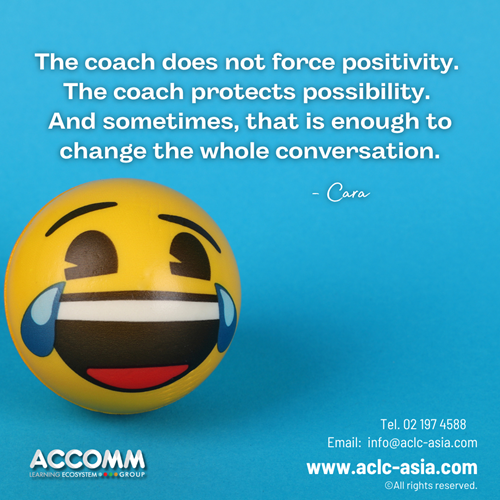
The coach does not force positivity. The coach protects possibility. And sometimes, that is enough to change the whole conversation.
A coach influences positive energy not by becoming louder, brighter, or more inspirational, but by being present enough to hold difficulty, curious enough to invite discovery, and grounded enough to help the client believe:
“This may be hard, but I am not helpless.” That is a different kind of energy. Not noisy. Not fake. Not decorated with motivational glitter. Just deeply human.
Article by Atchara Juicharern, Ph.D. (Cara) | CEO – AcComm Group | MCC
©AcComm Group


Comments